

FOR ORGANISATIONS
Workplace Neurodiversity Support for Employers
We help organisations understand how neurodiversity affects performance, communication, organisation, attention, and wellbeing.
Our services include workplace needs assessments, diagnostic assessments, coaching, and training for managers and teams.
Clear, role-relevant recommendations that support performance, retention, and reasonable adjustments.
What We Do
Our services support organisations to understand how neurodiversity can affect work performance, communication, organisation, attention, and wellbeing.
Practical services designed to support effective working.
Workplace Needs Assessment
Identify practical adjustments that support effective performance in the employeeʼs role.
Workplace Support Consultation
Identify practical strategies and adjustments to support effective working.
Integrated Diagnostic & Workplace Support
Understand cognitive profile and identify workplace adjustments within one structured process.
Workplace Strategy Coaching
Develop practical strategies for organisation, workload management, communication, and task completion.
Neurodiversity Training
Help managers and teams understand neurodiversity and implement effective support.
Select a service to view full details or arrange support.
Why Neurodiversity Support Matters
Neurodivergent employees often bring valuable skills such as analytical thinking, creativity, problem solving, and attention to detail. Differences in communication, attention, organisation, or sensory processing can create barriers within standard workplace structures.
Many adjustments are simple, low cost, and straightforward to implement.
1 in 7
People in the UK
are estimated to be neurodivergent, including ADHD, autism, dyslexia, and related differences.
3x
Retention Risk
Employees are more likely to leave roles where appropriate support is not in place.
£800M+
Estimated Cost
Estimated annual cost to UK employers associated with absence, reduced productivity, and staff turnover.
Appropriate workplace adjustments are often low cost and can have a significant positive impact on performance, confidence, and retention.
Workplace Needs Assessment (WPNA)
A Workplace Needs Assessment identifies practical adjustments that support effective performance in a specific role and working environment.
Purpose
To identify practical adjustments that support effective working within the role and workplace context.
Recommendations are tailored to job demands and organisational structures, ensuring they are realistic, proportionate, and straightforward to implement.
Common areas considered:
• workload and competing priorities
• written communication demands
• organisation and time management
• maintaining concentration
• processing verbal information
• task structure and workflow
• sensory or environmental distractions
What to Expect
- Review of job role, tasks, workload demands, and working environment.
- Discussion of current challenges, strengths, and preferred ways of working.
- Consideration of adjustments relating to communication, organisation, time management, technology, environment, and workflow.
- A structured report outlining practical recommendations that can be implemented within existing workplace processes.
Why this assessment can be helpful: Appropriate workplace adjustments can reduce barriers, support consistent performance, and improve confidence in role requirements. Providing reasonable adjustments also supports organisations in meeting responsibilities under the Equality Act 2010.
Pricing
Typically £850 per assessment.
Reduced rates may be available depending on the number of assessments requested.
How a Workplace Needs Assessment Works
A structured process designed to understand job demands and identify practical adjustments.
The process is collaborative and focused on producing clear guidance that supports both employee effectiveness and organisational requirements.
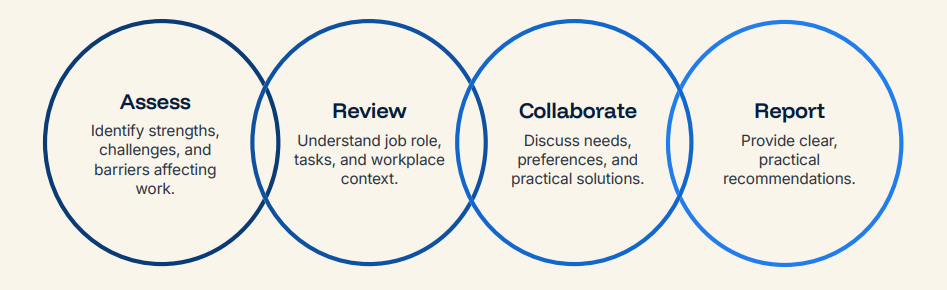
Recommendations are tailored to both the individual and the workplace context, supporting practical implementation within existing workplace systems.
Workplace Support Consultation
Helping employees understand how their thinking style affects job demands — and what to do about it.
A Workplace Support Consultation helps employees understand how their thinking style affects job demands and day-to-day work tasks. It focuses on identifying practical strategies and potential adjustments that make work more manageable and support consistent performance within the individual's role and working environment.
This can be used as a standalone service or as a starting point before a Workplace Needs Assessment or diagnostic assessment.
Designed to be
- Realistic and role-relevant
- Straightforward to implement
- Focused on reducing barriers
- Immediately actionable
Who it's for
Employees experiencing difficulties with:
Organisation & Workload
Struggling to manage competing priorities or structure daily tasks effectively.
Concentration & Task Completion
Finding it hard to sustain focus or follow tasks through to completion.
Communication
Experiencing challenges in workplace interactions or processing information.
Particularly helpful where there is uncertainty about why work feels more effortful, or what support would be most effective.
What to Expect
To develop a clearer understanding of how the individual works, and translate this into practical strategies and adjustments that reduce barriers within the role.
Understand
Gain insight into how your thinking style interacts with your specific job demands.
Identify
Pinpoint the adjustments and strategies most relevant to your role and environment.
Apply
Put realistic, role-relevant approaches into practice without delay.
Pricing
£295 per consultation
Reduced rates may be available where multiple consultations are requested.
If you proceed to a Workplace Needs Assessment within 4 weeks, £100 of the consultation fee can be deducted.
How This Differs from a Workplace Needs Assessment
Workplace Support Consultation
Focuses on understanding working patterns and identifying practical strategies that can be applied immediately. Does not provide formal documentation or structured recommendations required for reasonable adjustments.
Workplace Needs Assessment
Provides a structured review of job demands and workplace context, with clear recommendations suitable for discussion with employers, HR, or Occupational Health.
When to Consider a Workplace Needs Assessment
A Workplace Needs Assessment may be more appropriate in the following circumstances:
- Where written evidence is needed to support reasonable adjustments in the workplace.
- Where recommendations must be clearly linked to specific job demands and responsibilities.
- Where difficulties are significantly impacting performance across multiple areas of work.
- Where previous strategies or informal support have not produced meaningful improvement.
- Where HR, Occupational Health, or line management need to be involved in a structured and documented way.
Not sure which service is right for you? A Workplace Support Consultation can serve as a starting point — helping to clarify needs before progressing to a full Workplace Needs Assessment if required.
Workplace Strategy Coaching
Workplace strategy coaching provides structured support to help employees manage job demands effectively.
Coaching focuses on practical strategies tailored to the individual's role, responsibilities, and working environment, supporting consistent performance and reducing work-related stress.
Coaching can be used alongside a Workplace Needs Assessment or as a standalone reasonable adjustment.
Who it's for
Employees experiencing difficulties with organisation, workload management, concentration, communication, or competing demands.
Particularly helpful where practical strategies are needed to implement workplace recommendations consistently.
Coaching focuses on practical strategies that can be applied directly within everyday work tasks.
Memory & Organisation
Strategies to support planning, prioritisation, task tracking, and managing competing demands.
Approaches are tailored to the structure and expectations of the role.
Focus & Stress Management
Strategies to support concentration, reduce overwhelm, and manage workload demands in a sustainable way.
Practical approaches that can be applied directly to work tasks.
Goal Setting & Development
Support with structuring goals, maintaining progress, and breaking work into manageable steps.
Strategies designed to be used independently between sessions.
Pricing
Typically £80 per session.
Package rates available where multiple sessions are booked.
The Impact of Workplace Strategy Coaching
Workplace strategy coaching supports employees to develop practical ways of managing job demands effectively.
Coaching can reduce barriers relating to organisation, workload management, communication, and maintaining focus, supporting more consistent and sustainable performance over time.
It also helps organisations understand how best to support the employee within their role.
Coaching is most effective when aligned with workplace adjustments and clear role expectations.
For the Employee
- Clearer understanding of effective ways of working
- More consistent approaches to organisation, prioritisation, and task completion
- Increased confidence in managing job demands
- Reduced likelihood of becoming overwhelmed by workload expectations
For the Organisation
- Clearer understanding of how to support the employee effectively
- Improved consistency in work output where challenges have previously created barriers
- Reduced likelihood of difficulties escalating without support
- Evidence of proactive approach to reasonable adjustments in line with the Equality Act 2010.
Integrated Diagnostic & Workplace Support
This integrated service combines a diagnostic neurodiversity assessment with a Workplace Needs Assessment within a single process.
It supports understanding of how cognitive differences may affect day-to-day work tasks, alongside clear recommendations that can be implemented within the employeeʼs role and working environment.
Who it's for
Employees and organisations seeking both diagnostic clarity and practical workplace support.
Particularly helpful where there is uncertainty about whether neurodivergent traits may be contributing to workplace challenges, and where adjustments may be required.
Purpose
To identify cognitive strengths and areas of difference, and translate this understanding into clear, role-relevant workplace adjustments.
Recommendations are grounded in both assessment findings and the practical realities of the employees role.
What to Expect
- Structured diagnostic assessment exploring cognitive profile, learning differences, ADHD traits, and autistic characteristics where relevant.
- Consideration of how thinking style may influence work tasks, communication, organisation, and information processing demands.
- Review of job demands, working environment, and role expectations.
- Recommendations for reasonable adjustments, assistive technology, and practical workplace strategies.
- Clear report suitable for discussion with HR, Occupational Health, or line managers.
Why this approach can be helpful: Combining diagnostic assessment with workplace recommendations can reduce delays between assessment and support, ensuring recommendations are directly informed by assessment findings.
It also supports organisations to implement reasonable adjustments in a structured and evidence-informed way.
Pricing
Typically £1,800 per assessment
Reduced rates may be available depending on the number of assessments requested
Particularly helpful where previous support has been limited by lack of diagnostic clarity.
Neurodiversity in the Workplace Training
Training develops practical understanding of neurodiversity in workplace contexts, supporting managers and teams to respond confidently to different working styles.
Sessions focus on realistic workplace situations, helping organisations translate knowledge into day-to-day inclusive practice.
1
2
3
Understanding Neurodivergent Profiles
Overview of common neurodivergent thinking styles, including ADHD, autism, dyslexia, and dyspraxia.
Explores how differences may influence communication, organisation, information processing, and working preferences.
Reasonable Adjustments in Practice
Guidance on identifying and implementing reasonable adjustments in line with the Equality Act 2010.
Includes examples of adjustments, how to explore support needs collaboratively, and how to review effectiveness over time.
Supporting Inclusive Working Practices
Practical approaches to improving communication, flexibility, and clarity within teams.
Emphasises small adjustments to working practices that improve accessibility for a range of thinking styles.
Pricing
Tailored to your organisations needs
Please get in touch for a quote
Training can be delivered as standalone sessions or combined with assessment and coaching services.
Who We Work With
We work with organisations and individuals seeking practical, evidence-informed support relating to neurodiversity in the workplace.
Support ranges from individual workplace assessments to organisation-wide training and strategy development.
Across all settings, the approach remains collaborative, evidence-informed, and focused on practical outcomes for both the individual and the organisation.
EMPLOYERS & HR:
implementing reasonable adjustments and developing inclusive working practices.
EMPLOYEES:
seeking assessment, coaching, or support with workplace adjustments.

HR & PEOPLE TEAMS:
seeking guidance on supporting neurodivergent employees effectively.
ORGANISATIONS:
developing organisational understanding of neurodiversity and reasonable adjustments.
Across all services, the focus remains on practical, role-relevant recommendations that can be implemented within real workplace contexts.
The Benefits of Inclusive Workplaces
Supporting neurodiversity in the workplace can reduce barriers to performance and help employees work more effectively.
Clear adjustments and inclusive working practices can improve consistency, retention, and employee wellbeing.
Reduced Absence
Appropriate adjustments can reduce workplace barriers that may otherwise contribute to stress-related absence or reduced capacity.
Clear expectations and supportive working practices can support more consistent attendance.
Improved Retention
Employees who feel supported and understood are more likely to remain with their organisation, reducing recruitment and onboarding costs.
Boosted Productivity
When barriers relating to organisation, communication, or information processing are reduced, employees are better able to work in ways that align with their strengths.
This can support more consistent task completion and clearer communication within teams.
Legal Compliance
Structured assessment and documentation can support organisations in meeting their duties
under the Equality Act 2010.
Clear records of adjustment discussions and agreed support form part of an evidence-informed approach to workplace inclusion.
Inclusive working practices often benefit a wide range of employees, not only those with a formal diagnosis.
Ready to Build a More Inclusive Workplace?
Whether you are seeking support for an individual employee or developing a broader neurodiversity approach, we can help identify practical next steps.
Get in touch to discuss your organisations needs and identify the most appropriate support.
Book an Assessment
Workplace Needs Assessment or Integrated Diagnostic & Workplace Support to identify practical adjustments and support strategies.
Arrange Training
Neurodiversity training tailored to managers, HR teams, or wider staff groups.
Focused on practical workplace application.
Explore Coaching
Workplace strategy coaching supports employees to develop practical approaches to managing job demands.
Often used alongside workplace adjustments.
If unsure which service is most suitable, we can advise on the most appropriate starting point.